Short answer: leasing usually makes sense when you need the space for a few years and with standard specifications. Building your own makes sense when you plan to stay for more than ten years, need specific features or cannot find suitable space. For a simple 5,000 m² warehouse, the construction cost equals roughly 9–10.5 years of rent, before land and financing.
Every growing business reaches the same question sooner or later: lease a ready-made warehouse or build its own? There is no single number that answers it. It depends on how many years you will need the space, how specific your requirements are, how much capital you want to commit and whether suitable space is available to lease today.
This guide sets the two options side by side, with indicative 2026 figures and a simple worked example, so that the discussion with your board, your bank or your accountant starts from a common basis.
The two figures in the comparison
Rent: according to Geoaxis' Logistics Values Observatory 2026, as reported in the Greek press in March 2026, modern warehouses closed 2025 at €5.75–6 per m² per month, with almost no modern space available. Rents vary by area, size and specification, and are usually indexed every year.
Construction: the cost depends on what the building will house. According to the breakdown in our warehouse construction cost guide, a simple dry-storage warehouse without offices costs an indicative €550–650 per m² for the building and €80–100 per m² for external works and infrastructure, or about €630–750 per m² in total, excluding land and equipment.
An industrial building, which can also work as a factory, costs more, an indicative €700–900 per m²: a heavier floor, more capable building services, stricter fire protection, offices and staff areas. The comparison with leasing has to use the cost of the building you actually need.
The two figures are not directly comparable. Rent is an operating expense paid every month. Building is an investment that creates a property with value, but it ties up capital and needs land.
A simple example: a 5,000 m² warehouse
Take a simple 5,000 m² dry-storage warehouse without offices:
- Leasing at €6/m² per month: about €30,000 a month, or about €360,000 a year, before indexation.
- Building at €630–750/m²: about €3.15–3.75 million, excluding land and equipment.
The construction cost equals roughly 9 to 10.5 years of rent. For a building that will also house production the ratio rises, but space like that is rarely available to lease. That ratio is only the starting point. For a fair comparison, add:
- The cost of the land, if you do not already own it.
- The cost of financing, or the opportunity cost of the capital.
- Insurance, maintenance and property taxes borne by the owner.
- Annual rent indexation and service charges.
- The tax treatment of each option, best reviewed with your accountant.
- The value of the property at the end of the period you are considering.
Leasing and building: comparison table
| Criterion | Leasing | Building your own |
|---|---|---|
| Upfront capital | Deposit and fit-out of the space | Land, design and construction |
| Monthly cost | Rent with annual indexation | Loan repayments, maintenance, insurance |
| Time to operation | Short, if suitable space exists | Design, permitting and construction |
| Specification | Whatever the available space offers | Designed around your own operation |
| Flexibility | Move when the lease ends | Expand on the same plot, if planned for |
| At the end of the period | No asset remains | A property with value remains |
When leasing makes sense
- When you need the space for a few years, or your volumes are not yet stable.
- When available space meets your needs without major alterations.
- When the capital earns more in other parts of the business.
- When the warehouse serves standard dry storage with no special requirements.
When building makes sense
- When you plan to stay in the same place for more than ten years.
- When you need specific features: high clear height, heavy floor loads, cold storage, production areas or hygiene requirements.
- When no suitable space is available to lease in the area you need.
- When you want to plan now for future expansion on the same plot.
- When the roof can carry solar panels for self-consumption, cutting the facility's running costs.
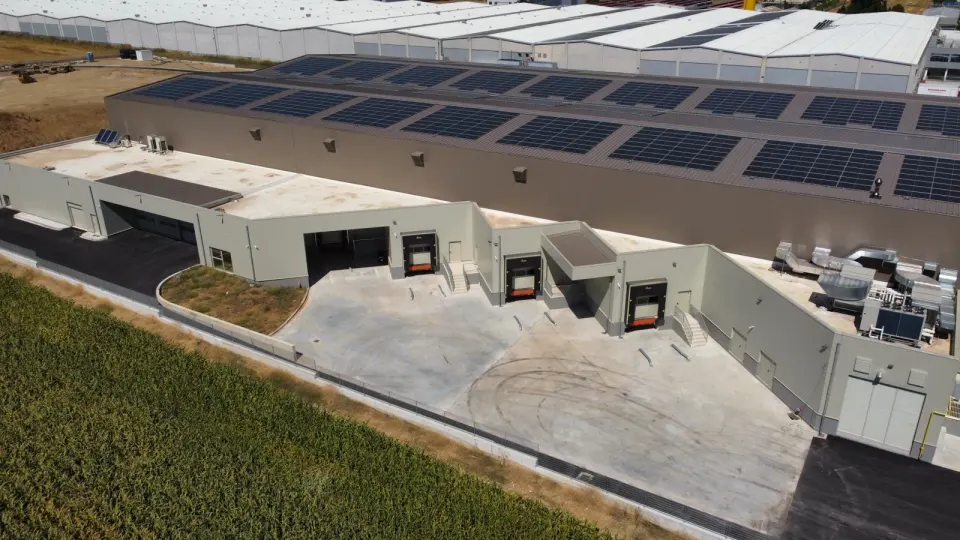
At the AVEK VEKRAKOS coffee production plant, production, packaging and distribution had to share one building with separate flows and a roof designed for solar panels. Space like that is rarely available to lease.
There is also a third route
Between the two options sit arrangements such as build-to-suit, where an investor builds to your specification and you lease the building on a long-term contract, and sale and leaseback of a building you already own.
Either way, the building still has to be designed and built properly. We build both for the end user and for the investor who will lease it out.
Time matters in both cases
Leasing starts quickly only if space exists. Building needs design, permitting and a site programme, so the decision has to be made several months before you need the space.
As an indication, the 13,000 m² JUMBO store in Katerini was built in one year. The actual duration of each project depends on its size, the site and how far the design has progressed.
Before you decide, answer six questions
- How many years will you need the space?
- How much will your needs grow, in floor area or storage height?
- Is space with your specification available to lease in the area you want?
- Do you own land, or will you need to buy it?
- How will construction be financed, and what does that capital cost?
- What will the property be worth to the business in ten or twenty years?