Service
Roadworks & Infrastructure
Road access, networks and infrastructure that keep your facility moving.
Service
Road access, networks and infrastructure that keep your facility moving.
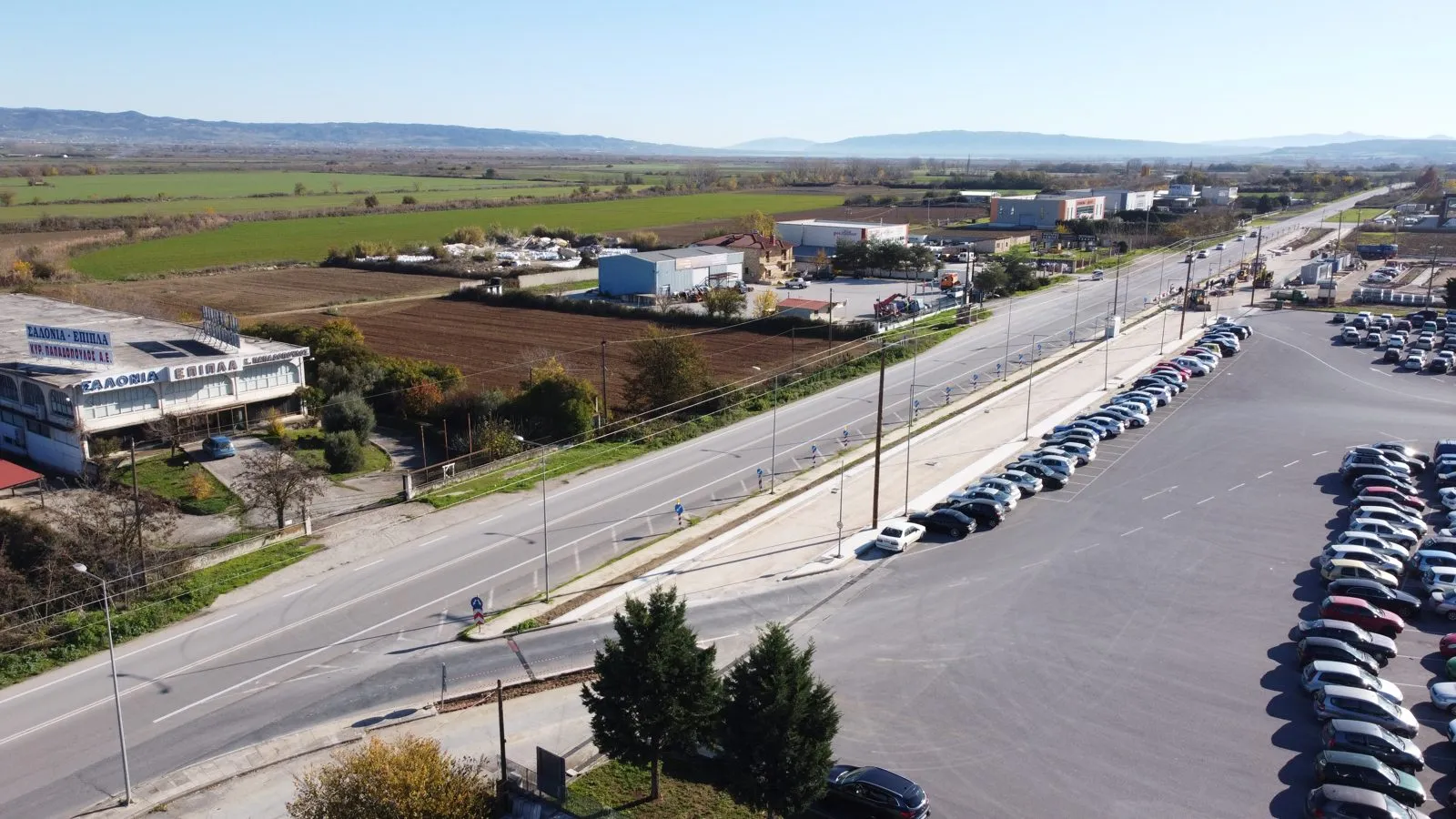
An industrial facility is worth only as much as its access. We build the road connections, intersections and networks that let heavy vehicles enter and leave safely without breaking the flow of the main axis. In Thessaloniki we built the traffic connection extension and intersection serving the MASOUTIS, JUMBO and AVEK VEKRAKOS facilities, with all stores fully trading throughout.
What the project covers
Excavation, fill, level formation and subgrade compaction. Fill is placed in layers with compaction tested at each layer. The subgrade determines the life of the pavement more than the final asphalt course does.
Sub-base and base with controlled grading and compaction. Layer thicknesses follow from the pavement design, based on the expected load and the frequency of heavy-vehicle passes. Areas used by articulated trucks demand considerably more than an ordinary road.
Asphalt base, levelling and skid-resistant wearing course. The number and thickness of layers are set by the design, as is the mix type. Laying temperature and compaction determine final durability more than the quantity of material.
Pipes, manholes, gully gratings and connection to the outfall. Pipe sizing is calculated for the catchment area and the local rainfall intensity, not from standard dimensions. Connection to the outfall requires its own approval and is programmed early.
Deceleration and acceleration lanes, islands, truck turning radii. Junction geometry follows from the largest vehicle that will use it and the speed of the main road. Construction requires an approved design and a permit from the road authority.
Road marking and vertical signage to specification. In manoeuvring yards, marking is not decorative: it defines vehicle routes, waiting positions and pedestrian walkways, and reduces yard accidents. It is applied after the pavement has cured.
Delineation, drainage and pedestrian access. Kerbs and channels guide water to the gullies and protect the edges of the asphalt, which is normally where deterioration starts. Pavements separate staff movement from vehicle routes.
Poles, luminaires and supply network. Pole positions are planned so they cast no shadows on loading positions and do not obstruct manoeuvring. The supply network is laid underground, with inspection chambers and provision for future extension.
Public works and infrastructure
Beyond private access works, we deliver roadworks and infrastructure under public contracts: road construction, junctions, stormwater networks, kerbs, pavements, signage and street lighting.
Public works differ less in the building and more in the process: they require full material documentation, scheduled quality testing at every layer, measurement records and continuous cooperation with the supervising authority.
Our experience from industrial projects carried out with traffic running transfers directly. Phasing, temporary diversions and site signage are the same discipline, whether the site is a retail park or a municipal road.
Related projects
Frequently asked questions
Yes, and it is the norm on commercial projects. We phase the works with temporary diversions and signage so customer and supplier access is never cut.
For a new connection to a regional or national road, usually yes, with approval from the competent authority. We handle the study and permitting alongside construction.
Yes, under public procurement frameworks, with full documentation and the required quality controls.
Depending on length, networks and phasing, usually 2 to 6 months. Working with traffic open lengthens the schedule but protects your operation.
Yes. Asphalt paving, parking, pavements, fencing, planting and networks are all part of our scope.
It is the permitted connection of a facility to the road network, with the geometry and lanes that safe entry and exit demand. It is required when new access is created or when the use and traffic of the facility change materially. It is often the stage that delays an industrial or retail project the most.
Through compaction testing at each layer, checks on aggregate grading, and verification of layer thickness before the next layer is placed. Testing happens during execution rather than at the end, because an under-compacted layer cannot be corrected once it is covered.
Yes. We install water supply and sewerage, underground electrical networks and telecom ducting, together with inspection chambers and connections. Networks are built before the pavement layers, so no trench has to be cut into new asphalt.
Send us a few details and receive an initial assessment within one business day.
Request an assessment