Service
Asphalt Paving
Pavements sized for real loads, not for a minimum thickness.
Service
Pavements sized for real loads, not for a minimum thickness.
Most asphalt failures are not caused by the asphalt but by what sits beneath it. A yard taking 40-tonne trucks daily needs compacted subgrade, a properly sized base and engineered drainage. We size the pavement from actual traffic loading and vehicle types, not from a standard thickness.
What the project covers
Layer sizing based on loads, traffic frequency and subgrade. We do not design from vehicle counts but from equivalent axle loads: one truck stresses the pavement incomparably more than hundreds of cars. The thickness of each layer follows from that calculation.
Excavation, improvement where required, compaction with density testing. Where the subgrade is soft or holds moisture, it is replaced or stabilised before we go further. It is the stage nobody sees in the finished job and the one that decides whether the pavement lasts.
Crushed aggregate of controlled grading, laid and compacted in layers. Each layer is spread to a controlled thickness and compacted before the next goes down, because an under-compacted layer cannot be corrected once covered. Thickness and grading come from the design, not from what material happens to be available.
Bonding coat to tie the layers together. Without it the asphalt layers behave independently rather than as one structure, which leads to slippage and early cracking. The surface must be clean and dry before it is applied.
Asphalt base, levelling and skid-resistant wearing course. The mix type is selected for the use: a yard with standing trucks and manoeuvring is stressed differently from a road carrying traffic at steady speed. Laying temperature and compaction determine final durability more than the quantity of material.
Falls, channels, manholes and gratings so water never ponds. Falls are designed with the pavement rather than afterwards, because water is the main enemy of the base. On large manoeuvring yards drainage is zoned, so no truck route crosses a point where water collects.
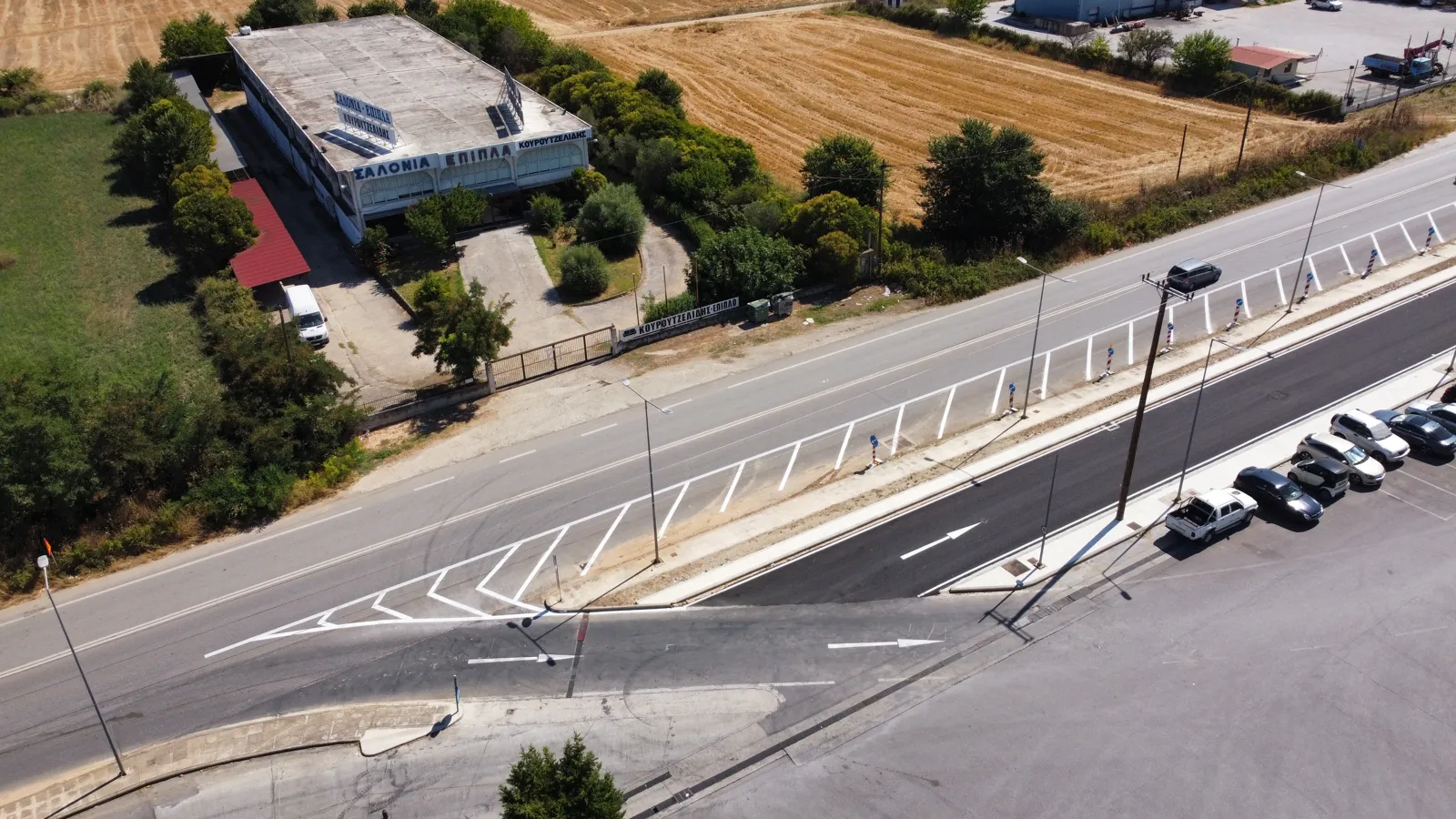
Parking bays, circulation aisles, loading and pedestrian zones. In an industrial yard, marking is a safety tool: it defines where staff walk, where vehicles wait and where parking in front of docks is prohibited. It is applied once the wearing course has cured.
Milling, localised repairs and resurfacing of existing areas. Before proposing a solution we establish whether the problem is at the surface or the base has failed, because a new course over a failed base will crack again within a short time. We work in phases so the facility stays operational.
When a repair is enough and when reconstruction is needed
Before deciding whether a repair is enough or reconstruction is needed, the pavement has to be read. The form of the damage shows where the problem sits, and reading it wrong costs twice: once for the intervention and again when the damage returns.
Surface cracking and loss of aggregate from the wearing course are dealt with by milling and a new surface. Rutting along wheel paths, settlement and crocodile cracking show that the problem lies in the base or the subgrade and cannot be solved at the surface.
The critical spots are around manholes, at the edges of the asphalt and where trucks stand for hours. That is usually where failure starts, and where a timely local repair prevents a full reconstruction.
Related projects
Frequently asked questions
That cannot be answered without data. We need vehicle types and numbers, traffic frequency and subgrade quality. A car park and a truck manoeuvring yard differ substantially in structure.
Once the wearing course has cooled, usually within hours for light vehicles. For heavy vehicles we advise a wait based on conditions and temperature.
Yes. On operating sites we phase the works so a route always remains available for trucks and customers.
Yes. Depending on condition, we carry out localised repairs, milling and a new wearing course, or full reconstruction where the base has failed.
Almost always because of inadequate falls or a missing drainage network. Standing water undermines the base and accelerates failure — drainage is designed with the pavement, not after it.
Asphalt has a lower initial cost, is faster to build and can be repaired locally. Concrete performs better under static loads, repeated manoeuvring in the same spot and fuel or oil spillage. On many sites the right answer is a mix: concrete at the dock positions and asphalt on the circulation routes.
Yes. Laying requires a dry surface and temperatures that allow proper compaction before the mix cools. In cold or wet conditions compaction is never completed and the layer does not reach its design strength, so we programme accordingly and do not lay in unsuitable conditions.
It is decided by three things: subgrade compaction, base sizing and drainage. When all three are right, the area needs only periodic maintenance and local repairs. When one is missing, deterioration appears early regardless of the quality of the wearing course.
Send us a few details and receive an initial assessment within one business day.
Request an assessment